即时发布
任何作家都可以告诉你谁叙述了一个故事对观众产生了重要差异。一项新的研究发现,与第三方演示者相比,观众对科学视频相同的是对科学视频的努力对呈现自己工作的研究人员提供积极响应。
“We wanted to see how effective researchers could be at presenting their own work in science videos aimed at the public,” says Selina Ruzi, co-corresponding author of a paper on the work and a postdoctoral researcher at North Carolina State University. “We found that scientists seem to have an advantage when it comes to presenting their work.”
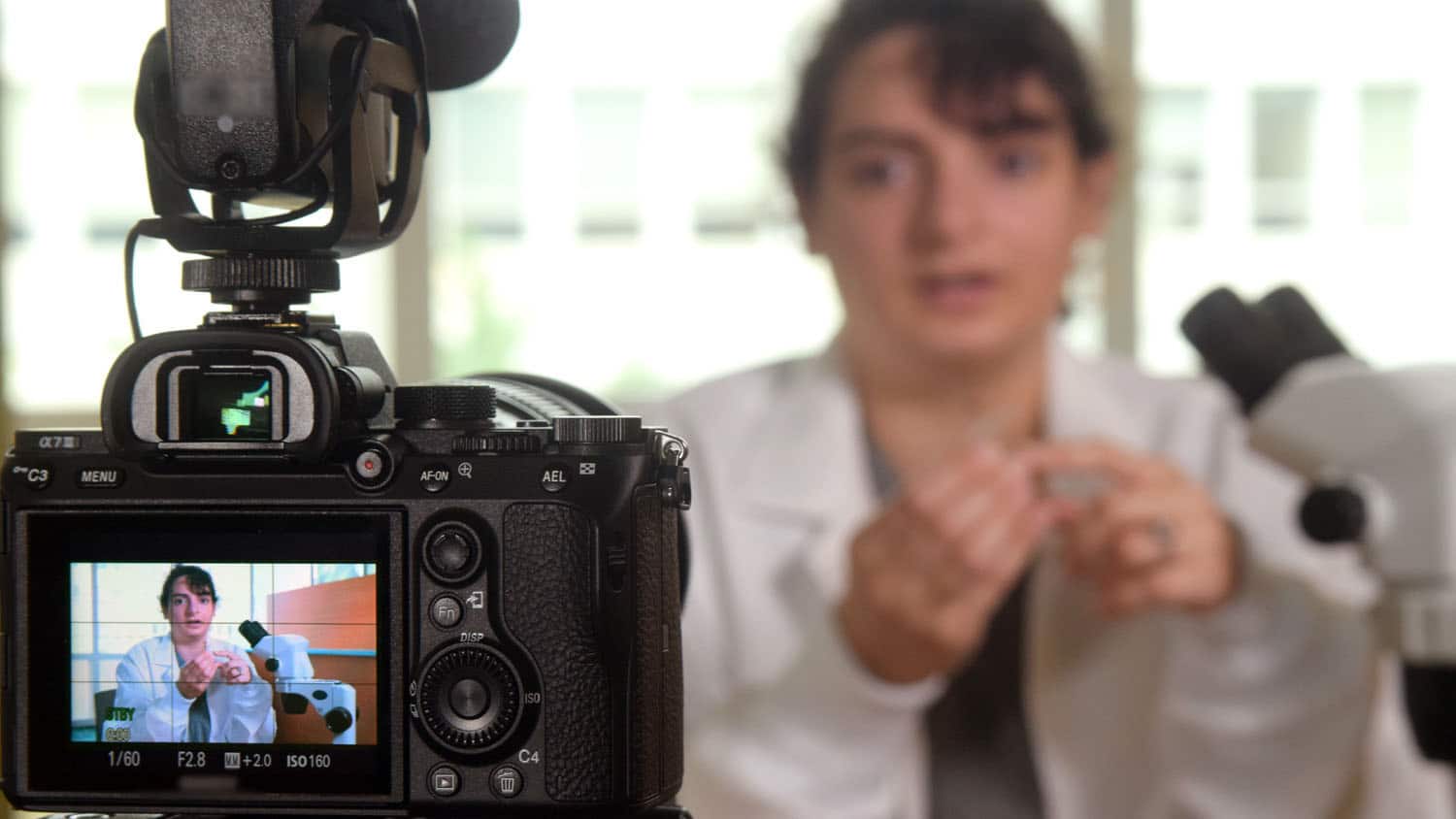
For the study, researchers enlisted 515 adults. Each study participant watched one of five different videos that the researchers created, telling a story of the discovery of a new ant species. One video featured a male researcher explaining his own work; one featured a female researcher explaining her work; one featured a male third-party presenter; one featured a female third-party presenter; and one video was presented in an infographic format with no presenter or audio narration.
After watching the video, participants completed a survey that asked them about the video, the presenter, and their views on science and scientists.
“研究人员 - 主持人被视为拥有比第三方演示者更专业的专业知识,”Ruzi说。“而研究员 - 主持人被视为更值得信赖,并且拥有更多的专业知识,而不是No-Shokesperson视频中的信息来源。
“We also found that participants who saw researcher-presented videos were more likely than people who saw the other videos to phrase survey responses in a way that made it clear that a person had done the research, as opposed to using language that suggested the research was done in a vacuum. First-person accounts helped humanize the science.”
虽然研究人员 - 主持人被视为拥有比第三方叙述者更专业的,但主持人的选择对参与者如何看待视频的整体可信度或他们所享有的程度。演示者尚未影响参与者对科学家的看法,或者对研究进行资金。
“我认为这里的发现是令人着迷的,因为我们发现视频之间实际上具有明显的效果,”Adrian Smith,工作协调人员和NC州的生物科学研究助理教授。“研究人员视频和第三方视频之间唯一的实际差异是在第三个人的第一人口中发言的几个情况。
“This tells me that scientists have an automatic leg up when it comes to reaching people via science videos. If we want to convey expertise and build trust, we have an advantage when we provide our own perspective and tell our own stories.”
“Many scientists are already making videos to communicate with other scientists,” Ruzi says. “But most of those scientists are not using language that can be understood by people outside of their discipline, or even their sub-discipline. If researchers use language that can be understood more broadly, they could reach a larger audience.”
从实用的角度来看,达成大的奥迪ence can help researchers comply with public communication requirements in grant agreements – such as the “broader impacts” requirements included in grants from the National Science Foundation. Public outreach is also associated with increases in scholarly metrics.
“这并不意味着所有研究人员都有义务从事公共沟通努力,”史密斯说,他还在北卡罗来纳自然科学博物馆领导了进化生物学和行为研究实验室。“并且显然需要专业的科学传播者。
“Rather, we think this research highlights an opportunity for scientists who are interested in public engagement efforts. And we think these findings could inform how professional communicators work with scientists to highlight their research.”
研究合作者表示,前进有两条清晰的研究。
“For one thing, the videos in this experiment were about the discovery of an obscure species of ant that would be unimportant to viewers,” Ruzi says. “What happens when the subject matter is something that is immediately important or relevant to them? Something that affects their health or well-being?”
史密斯说:“这也值得探索对第一个人的更多研究人员对展示他们的工作中的更多研究人员,从长远来看,这是对科学家的更多积极观点还是增加对研究资金的支持,”史密斯说。
本文,“Testing How Different Narrative Perspectives Achieve Communication Objectives and Goals in Online Natural Science Videos,” is published in the journal普罗斯一体。本文由亚利桑那州立大学的尼科利李共同撰写。该作品是通过国家科学基金会的支持,授予1906242。
- 船员 -
编辑注:The study abstract follows.
“测试不同的叙述视角如何实现在线自然科学视频中的通信目标和目标”
Authors:Selina A. Ruzi,北卡罗来纳州立大学;亚利桑那州立大学尼科尔M.李;北卡罗来纳州立大学和北卡罗来纳州立大学和北卡罗来纳自然科学博物馆
发表:10月13日,普罗斯一体
抽象的:通过网络媒体沟通的科学become a primary means of disseminating and connecting science with a public audience. However, online media can come in many forms and stories of scientific discovery can be told by many individuals. We tested whether the relationship of a spokesperson to the science story being told (i.e., the narrative perspective) influences how people react and respond to online science media. We created five video stimuli that fell into three treatments: a scientist presenting their own research (male or female), a third-party summarizing research (male or female), and an infographic-like video with no on-screen presenter. Each of these videos presented the same fabricated science story about the discovery of a new ant species (Formicidae). We used Qualtrics to administer and obtain survey responses from 515 participants (~100 per video). Participants were randomly assigned to one of the videos and after viewing the stimulus answered questions assessing their perceptions of the video (trustworthiness and enjoyment), the spokesperson (trustworthiness and competence), scientists in general (competence and warmth), and attitudes towards the research topic and funding. Participants were also asked to recall what they had seen and heard. We determined that when participants watched a video in which a scientist presented their own research, participants perceived the spokesperson as having more expertise than a third-party presenter, and as more trustworthy and having more expertise than the no-spokesperson stimuli. Viewing a scientist presenting their own work also humanized the research, with participants more often including a person in their answer to the recall question. Overall, manipulating the narrative perspective of the source of a single online video communication effort is effective at impacting immediate objective outcomes related to spokesperson perceptions, but whether those objectives can positively influence long-term goals requires more investigation.