For Immediate Release
Wrapping potato seeds in biodegradable paper made from unusable parts of banana plants reduces the infestation and harmful effects of a nasty plant pathogen – a worm called the potato cyst nematode – and sharply increases potato size and yields.
Reported in自然的可持续性, 最近study显示了香蕉纸帮助是干扰信号en the plant and the worm, blocking pathogen infestation and growth. Potato seeds planted inside the paper – with and without miniscule amounts of a worm-killing chemical called abamectin – grew larger and more abundantly than potatoes planted without the paper or in fields sprayed with abamectin alone.
Potato yields were up to five times larger than controls when the banana paper was dosed with 100 nanograms of abamectin – a tiny fraction of the amount normally sprayed on fields by farmers to protect potatoes.

“We knew that the banana paper would be successful, but not to this extent,” said Charles Opperman, a co-corresponding author of the study and professor of plant pathology at North Carolina State University. “We previously had some success increasing yam yields in Benin using this ‘wrap-and-plant’ method, but nothing on the order reported here with potato.”
Potato cyst nematodes are a global scourge that can cause severe damage to potatoes; in some areas in Africa potato yields declined by 60% after infestation, the researchers say.
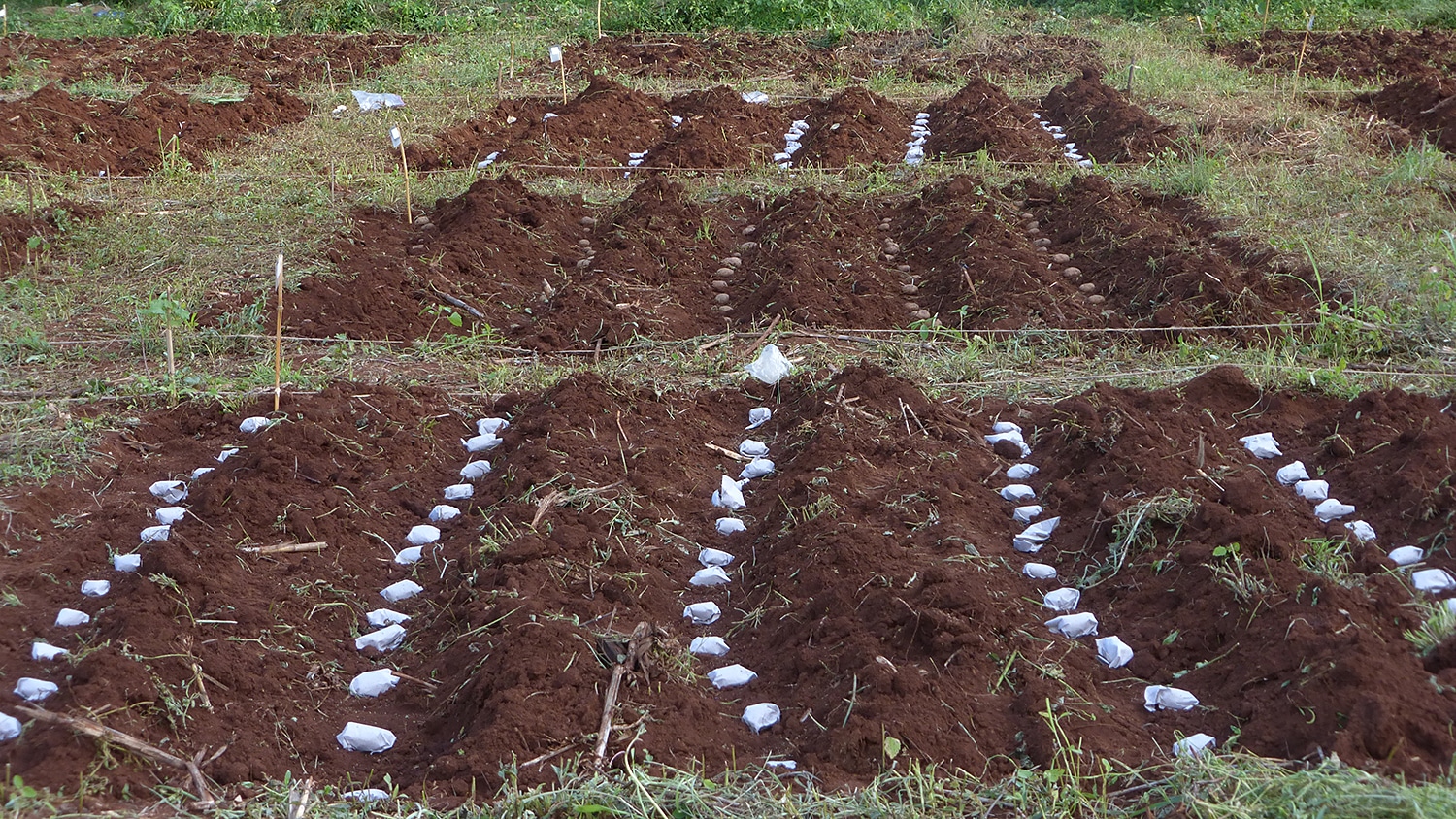
The paper was made in NC State’s Department of Forest Biomaterials from the aqueous slurry of banana waste product, said Tahira Pirzada, a study co-author and postdoctoral research scholar in NC State’sDepartment of Chemical and Biomolecular Engineering。当从浆液中取出水时,形成了长长的柔性香蕉纸。剪纸器用于将纸张成小块,可以将纸包裹在土豆种子上。然后将这些包裹种植。
In field tests designed to test the banana paper’s efficacy against the potato cyst nematode, researchers in Kenya grew potatoes four different ways: wrapped in banana paper dosed with low doses of abamectin; wrapped in banana paper without abamectin; without any banana paper but in fields sprayed with abamectin; and in control fields without banana paper wraps or chemical treatment.
The results showed that the banana paper – with or without the worm-killing chemical – effectively prevented potato infestation in the field and increased potato yields and size. Potato root systems also were more dense when paper was utilized.
为了进一步测试该论文的角色,研究人员还进行了实验室研究,将病原体暴露于从马铃薯植物的根中释放的化学物质,称为根渗出液,有或没有香蕉纸。该研究的主要作者朱丽叶·奥乔拉(Juliet Ochola)从事肯尼亚实验室研究,现在是NC State Ph.D.香蕉纸说,植物病理学的学生吸附了这些化学药品并将其固定。
“Nematodes love these chemicals; they stimulate the nematode’s growing process and inform the nematode about the best locations to infect the plant,” Ochola said. “But the banana paper – with or without doses of abamectin – disrupts the signaling between the potato and the nematode. The nematode can’t detect those compounds, so it doesn’t grow and it doesn’t know where to infect the plant.”
The researchers are currently testing the “wrap-and-plant” technique on other vegetable crops, including yams, sweet potatoes and cassava, and are looking to commercialize the technology, which could drive economic development in Africa.
“The beauty of this approach is that it is straightforward, inexpensive and sustainable; farmers can adopt it on a smaller scale,” Pirzada said. “No chemicals are used in the paper-making process. This is the way forward.”
肯尼亚国际热带农业研究所(IITA)和国际昆虫生理与生态学中心(ICIPE)合作的合作者共同撰写了这项研究。IITA的Danny Coyne和Icipe的Baldwyn Torto是该论文的共同作者。在北卡罗来纳州,埃里克·戴维斯(Eric Davis)昆虫学和植物病理学系,化学与生物分子工程系的Saad Khan和来自森林生物材料部co-authored the paper. Laura Cortada, Onesmus Mwaura, Meklit Tariku, Shawn A. Christensen and Margaret Ng’ang’a also co-authored the paper.
这项工作得到了北卡罗来纳州的支持;针对根,块茎和香蕉的CGIAR研究计划;法案和梅琳达·盖茨基金会(Melinda Gates Foundation)在格兰特(Grant Nos)领导下。OPP1118810,OPP1196989;挪威发展合作机构,研究,创新和高等教育赠款编号RAF-3058 KEN-18/0005(CAP-AFRICA);美国农业部,农业研究服务部,协议号。58-6615-3-011 f;国际昆虫生理与生态学的核心捐助者:瑞典国际发展合作局,瑞士发展与合作局,埃塞俄比亚联邦民主共和国和肯尼亚政府。
-Kulikowski-
Note to editors: An abstract of the paper follows.
“在东非管理可持续马铃薯囊肿线虫的包装和植物技术”
Authors: Juliet Ochola, Laura Cortada, Onesmus Mwaura, Meklit Tariku, Shawn A. Christensen, Margaret Ng’ang’a, Ahmed Hassanali, Tahira Pirzada, Saad Khan, Lokendra Pal, Reny Mathew, Dick Guenther, Eric Davis, Tim Sit, Danny Coyne, Charles Opperman and Baldwyn Torto
Published: Feb. 28, 2022 in自然的可持续性
DOI: 10.1038/s41893-022-00852-5
Abstract:可再生的环保作物保护选择对于实现可持续农业至关重要。在这里,我们证明了使用可生物降解的木质纤维素香蕉纸基质作为种子包裹,用于保护马铃薯植物免受马铃薯囊肿线虫(PCN)的保护Globodera rostochiensis。Potato cyst nematodes are devastating quarantine pests of potato globally. In East Africa,G. Rostochiensis最近出现了对马铃薯生产的严重威胁。将木质纤维素香蕉纸基质中的种子土豆包裹起来大大减少G. Rostochiensis相对于农民实践,肯尼亚的现场接种物和马铃薯的产量最多增加了五倍,无论是否与超低剂量的nematicide amabamectin(ABM)浸渍。明显地,经ABM处理的香蕉纸比传统建议低约1,000倍,减少了PCN接种物。测定和分析表明,木质纤维素基质通过吸附关键的PCN孵化和具有印度少年宿主位置化学物质,破坏了寄生虫 - 主机信号传导。恢复实验证实了这些宿主位置化学品的吸附。我们的研究表明,使用废物有机材料可持续地管理PCN,并可能使用其他农作物害虫,同时增加马铃薯的产量。