For Immediate Release
In a newstudy,北卡罗来纳州立大学的研究人员使用人工智能来预测美国大陆上可能发生的洪水破坏,这表明联邦紧急事务管理局最近的洪水地图并未捕获全部洪水风险。
In the study, published in环境研究信,研究人员发现,在整个14年的时间里,全美国一百万英里的土地上有很高的洪水破坏可能性(包括货币损害,人身伤害和生命损失)。这比FEMA地图确定的洪水风险区大790,000平方英里。
“We’re seeing that there’s a lot of flood damage being reported outside of the 100-year floodplain,” said the study’s lead author Elyssa Collins, a doctoral candidate in the数控状态Center for Geospatial Analytics.“有很多地方容易受到洪水的影响,并且由于它们不在洪泛区之外,这意味着他们不必遵守可以帮助保护人民和财产的保险,建筑法规和土地使用要求。”
It can cost FEMA as much as $11.8 billion to create national Flood Insurance Rate Maps, which show whether an area has at least a 1% chance of flooding in a year,according to a 2020 report from the Association of State Floodplain Managers。研究人员说,他们使用机器学习工具估算洪水风险的方法提供了一种随着条件变化或更多信息的可用性而快速更新洪水图的一种方法。
“This is the first spatially complete map of flood damage probability for the United States; wall-to-wall information that can be used to learn more about flood risk in vulnerable, underrepresented communities,” saidRoss Meentemeyer, Goodnight Distinguished Professor of Geospatial Analytics at NC State.
为了创建其计算机模型,研究人员使用了报道的美国造成的洪水破坏数据,以及其他信息,例如土地靠近河流还是溪流,土地覆盖,土壤类型和降水类型。计算机能够从实际损坏的实际报告中“学习”,以预测每个像素的土地的高洪水损坏可能性。他们为美国的每个流域创建了单独的模型。
“我们的模型不是基于物理学或水流的机制;我们正在使用机器学习方法来创建预测。”柯林斯说。“我们开发了将预测变量的模型 - 与洪水损害有关的变量,例如极端降水,地形,房屋与河流的关系 - 与国家海洋和大气管理局的洪水损害报告有关。这是非常快的 - 我们为美国流域的车型平均跑了五个小时。”
The actual flood damage reports they used to “train” the models were publicly available reports from NOAA made between December 2006 and May of 2020. Compared with recent FEMA maps downloaded in 2020, 84.5% of the damage reports they evaluated were not within the agency’s high-risk flood areas. The majority, at 68.3%, were located outside of the high-risk floodplain, while 16.2% were in locations unmapped by FEMA.
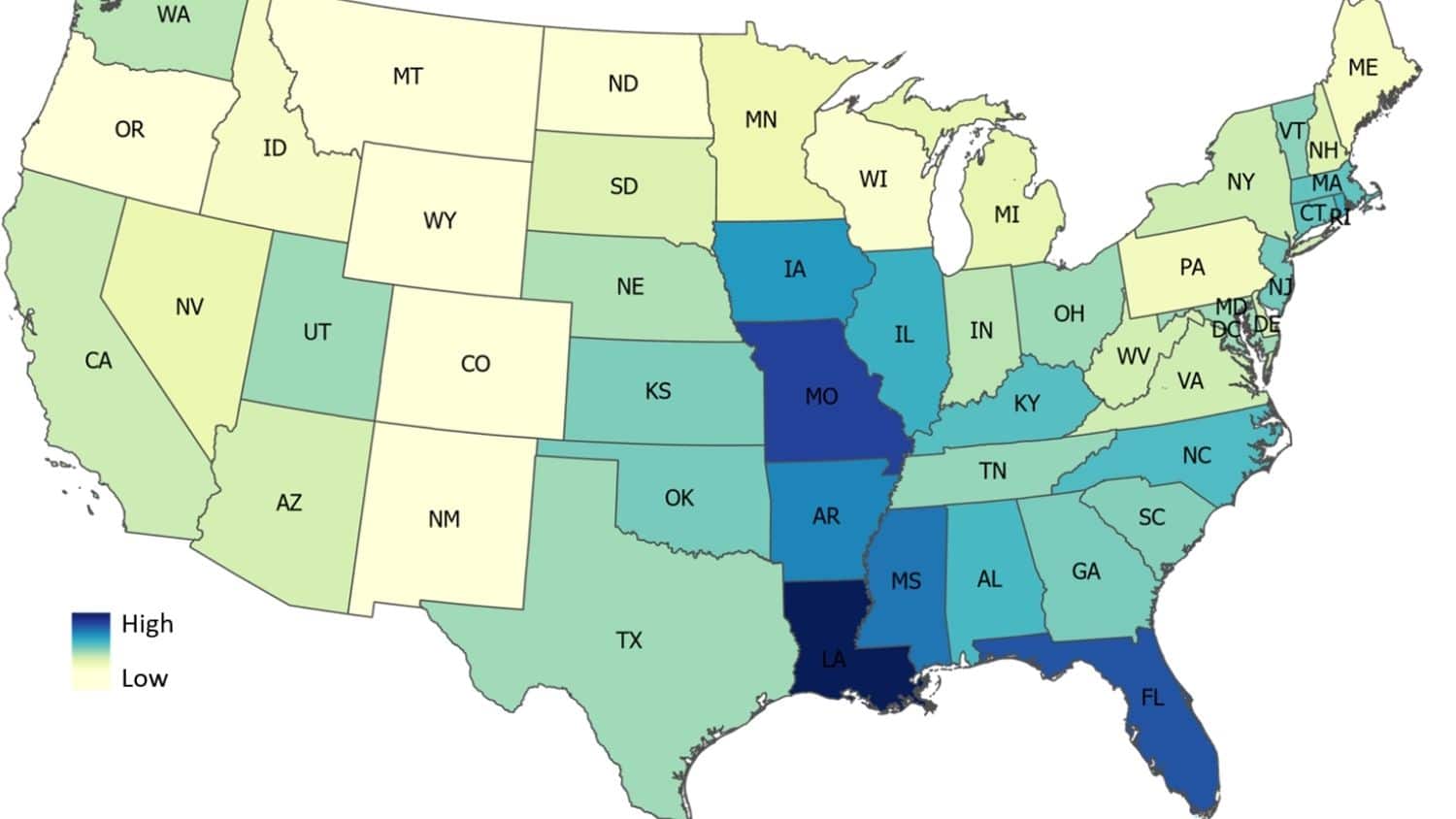
When they ran their computer models to determine flood damage risk, they found a high probability of flood damage for more than 1.01 million square miles across the United States, while the mapped area in FEMA’s 100-year flood plain is about 221,000 square miles. Researchers said there are factors that could help explain why the differences were so large, including that their machine-learning-based model assessed damage from floods of any frequency, while FEMA only includes flooding that would occur from storms that have a 1% chance of happening in any given year.
柯林斯说:“可能,FEMA低估了洪水损害的暴露。”
One of the biggest drivers of flood damage risk was proximity to a stream, along with elevation and the average amount of extreme precipitation per year. The three Census regions with the highest probability were in the Southeast. Louisiana, Missouri, the District of Columbia, Florida and Mississippi had the highest risk of any U.S. state or district in the continental United States. Of the 30 most high-risk counties, North Carolina had three: Dare, Hyde and Tyrrell.
In their model, researchers used historical climate data. In the future, they plan to account for climate change.
In the meantime, researchers say their findings, which will be publicly accessible, could be useful for helping policymakers involved in land-use planning. They also represent a proof-of-concept method for efficiently updating flood maps in the future.
“There is still work to be done to make this model more dynamic,” Collins said. “But it’s part of a shift in thinking about how we approach these problems in a more cost-effective and computationally efficient manner. Inevitably, with climate change, we’re going to have to update these maps and models as events occur. It would be helpful to have future estimates that we can use to prepare for whatever is to come.”
The study, “Predicting flood damage probability across the conterminous United States,” was published online Feb. 21, 2022, in环境研究信。In addition to Collins and Meentemeyer, other authors included Georgina M. Sanchez, Adam Terando, Charles C. Stillwell, Helena Mitasova and Antonia Sebastian. This project was supported by the U.S. Geological Survey Southeast Climate Adaptation Science Center (G19AC00083) and the North Carolina State University Sea Grant program (R/MG-2011).
-oleniacz-
给作者的注释:摘要跟随。
“预测整个美国的洪水破坏概率”
作者:Elyssa L. Collins,Georgina M. Sanchez,Adam Terando,Charles C. Stillwell,Helena Mitasova,Antonia Sebastian和Ross K. Meentemeyer。
Publishedonline in环境研究信on Feb. 21, 2022
DOI: 10.1088/1748-9326/ac4f0f
Abstract:洪水自然灾害的主要原因damages in the United States, with billions of dollars incurred every year in the form of government payouts, property damages, and agricultural losses. The Federal Emergency Management Agency oversees the delineation of floodplains to mitigate damages, but disparities exist between locations designated as high risk and where flood damages occur due to land use and climate changes and incomplete floodplain mapping. We harnessed publicly available geospatial datasets and random forest algorithms to analyze the spatial distribution and underlying drivers of flood damage probability caused by excessive rainfall and overflowing water bodies across the conterminous United States. From this, we produced the first spatially complete map of flood damage probability for the nation, along with spatially explicit standard errors for four selected cities. We trained models using the locations of historical reported flood damage events (n = 71,434) and a suite of geospatial predictors (e.g., flood severity, climate, socio-economic exposure, topographic variables, soil properties, and hydrologic characteristics). We developed independent models for each hydrologic unit code level 2 watershed and generated a flood damage probability for each 100-m pixel. Our model classified damage or no damage with an average area under the curve accuracy of 0.75; however, model performance varied by environmental conditions, with certain land cover classes (e.g., forest) resulting in higher error rates than others (e.g., wetlands). Our results identified flood damage probability hotspots across multiple spatial and regional scales, with high probabilities common in both inland and coastal regions. The highest flood damage probabilities tended to be in areas of low elevation, in close proximity to streams, with extreme precipitation, and with high urban road density. Given rapid environmental changes, our study demonstrates an efficient approach for updating flood damage probability estimates across the nation.
- Categories: