For Immediate Release
研究人员已经创造了新材料ry stretchable and extremely tough.
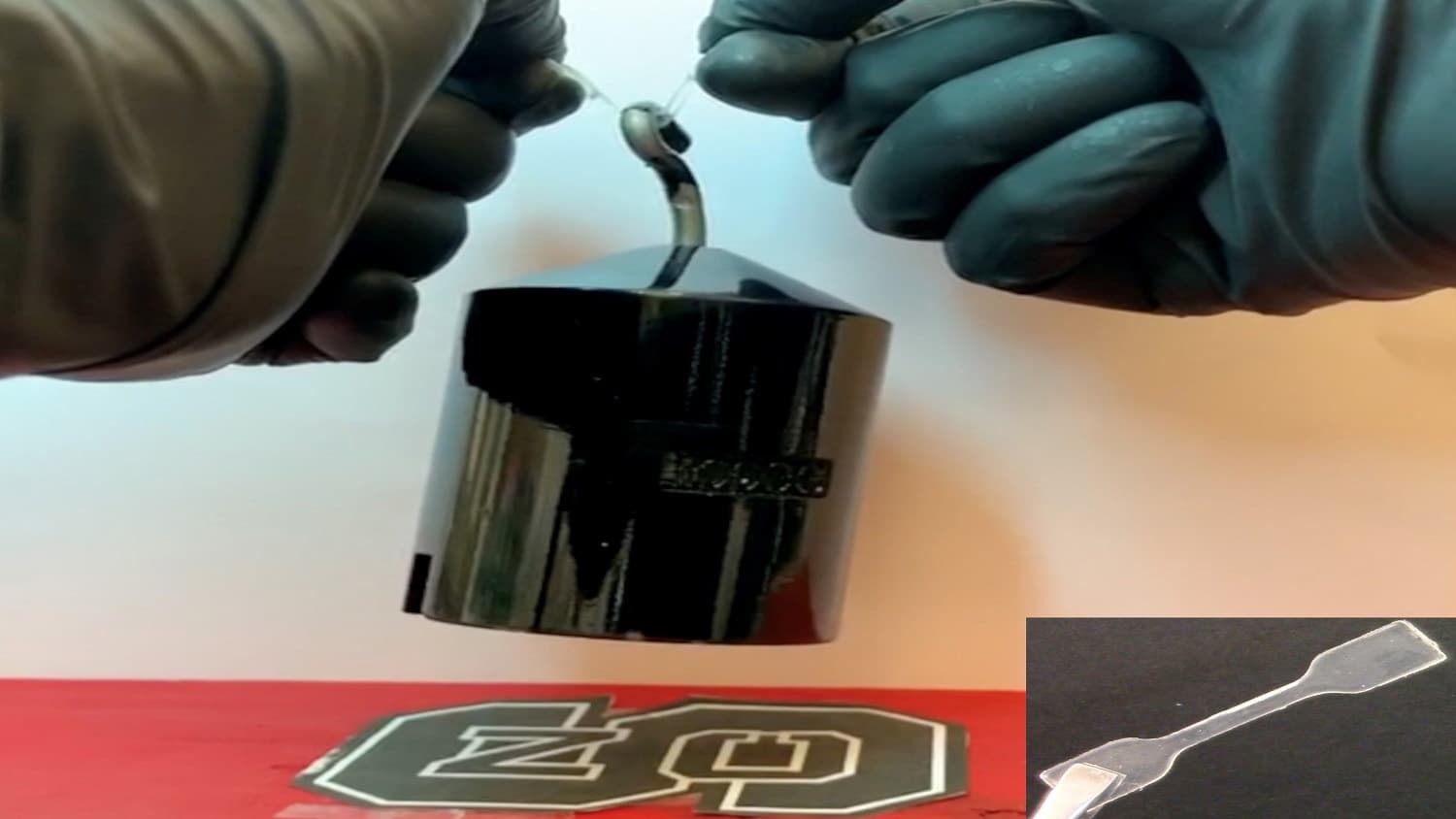
“可以变形的材料,但是很难打破或撕裂,是可取的,”在北卡罗来纳州的化学和生物分子工程的Camille&Henryfrefus教授的一篇论文中的迈克尔Dickey,“迈克尔Dickey”迈克尔迪基说大学。“自然擅长这一点;想到软骨作为一个例子。但是工程合成材料具有这些属性困难,这使我们的工作令人兴奋。“
新材料落在更广泛的IONOGEL类别下,这是含有在室温下液体的盐的聚合物网络。这些盐称为离子液体。
Dickey and his collaborators have made ionogels that are nearly 70% liquid, but have remarkable mechanical properties. Namely, they’re tough – meaning they can dissipate a lot of energy when you deform them, making them very difficult to break. They’re also easy to make, easy to process, and you can 3D print them.
“Hydrogels, which are polymer networks that contain water, are fairly common,” Dickey says. “For example, contact lenses are hydrogels. But ionogels have some advantages over hydrogels. Ionic liquids don’t evaporate like water, so you don’t have to worry about the ionogels drying out. Ionogels are also electrically and thermally stable and conduct electricity well, raising some interesting opportunities for future applications.”
为了制作新的IONOGEL,研究人员从聚丙烯酸(用于婴儿尿布中使用)的单体和聚丙烯酰胺(用于隐形眼镜),并使用紫外光将它们与离子液体溶液共聚。换句话说,它们采用聚丙烯酸和聚丙烯酰胺的成分,将它们放入离子液体中,并在其上闪烁,以产生共聚物,该共聚物包含单体和离子液体本身。
“The end result is significantly better than an average of the two materials,” Dickey says. “It is like adding 1+1 and getting 10. The resulting gel has the stretchability of polyacrylic acid and is even stronger than the polyacrylamide. In terms of toughness, it’s better than cartilage. But the differences between ionogels and hydrogels make them advantageous for different applications.”
In addition, the ionogels created by Dickey’s team also have self-healing and shape memory properties. You can stick two pieces of the ionogel together, expose it to heat, and it reforms a strong bond. By the same token, you can deform the ionogel into a temporary new shape, but it will return to its original shape when exposed to heat. The amount of heat needed depends on how quickly you want the material to “heal” or return to its normal shape. When exposed to a temperature of 60 degrees Celsius, the actions only take tens of seconds. Video of the ionogels can be seen athttps://www.youtube.com/watch?v=SoAxmv7I9KA。
“我们很兴奋,我们制作了一个真正显着的财产,可以很容易地制作 - 您只需使用广泛的可用聚合物,”Dickey说。“并且可以通过控制共聚过程中成分的比例来定制离子凝胶的性质。
“We’re already working with one industry partner, and are open to working with others to develop applications for this new breed of ionogels.”
The paper, “通过原位相分离的坚韧和可伸缩的离子凝胶,“发表在期刊上Nature Materials。本文的第一个作者是梅乡王,在国家秘书处的博士后研究,也与西安交通大学有一系列。本文由博士学位的穆罕默德希斯(博士)共同撰写。纳邦国家的学生;雅各布·蒂伦,NC州的合作者;vi khanh truong,聘请NC州的访问学者,聘请了RMIT大学;NC州的博士后研究员Jinwoo Ma;彭耀张和剑胡,西安交通大学;和内布拉斯加州大学的文谦。这项工作是通过沿海研究所的部分支持来完成的。
-shipman-
Note to Editors:The study abstract follows.
“通过原位相分离的”坚韧和可伸缩的离子凝胶“
Authors: Meixiang Wang, North Carolina State University and Xi’an Jiaotong University; Pengyao Zhang and Jian Hu, Xi’an Jiaotong University; Mohammad Shamsi, Jacob L. Thelen, Jinwoo Mma and Michael D. Dickey, North Carolina State University; Vi Khanh Truong, North Carolina State University and RMIT University; and Wen Qian, University of Nebraska-Lincoln.
Published: Feb. 21,Nature Materials
DOI: 10.1038/s41563-022-01195-4
Abstract:由于其优异的离子电导率,热和电化学稳定性和非挥发性,IONOGELS是技术装置的令人信服的材料。然而,大多数现有的离子凝胶患有低强度和韧性。在这里,我们通过随机共聚两种普通单体来报告一种简单的一步法,以实现超强和可拉伸的离子凝胶,其具有不同的聚合物在离子液体中的不同溶解度。丙烯酰胺和丙烯酸在1-乙基-3-甲基咪唑乙基硫酸乙酯中的共聚结果导致宏观均可的共价网络,其原位相分离:富含密集聚合物的相,其建立散热键,使能量散热并强化离子凝胶;和富含弹性溶剂的相位,使大菌株能够。这些离子凝胶具有高裂缝强度(12.6MPa),断裂能量(〜24kJ m-2) and Young’s modulus (46.5 MPa), while being highly stretchable (~600% strain) and having self-healing and shape-memory properties. This concept can be applied to other monomers and ionic liquids, offering a promising way to tune ionogel microstructure and properties in situ during one-step polymerization.
- Categories: