一所鱼学校
At NC State's Center for Marine Sciences and Technology in Morehead City, 18 veterinary medicine students get hands-on experience operating on fish.

鱼睡觉吗?
Yes, when properly anesthetized.
And that’s the goal of a unique one-week selective class taught annually by NC State professors Craig Harms and Gregory Lewbart at the Center for Marine Sciences and Technology (CMAST) in Morehead City.
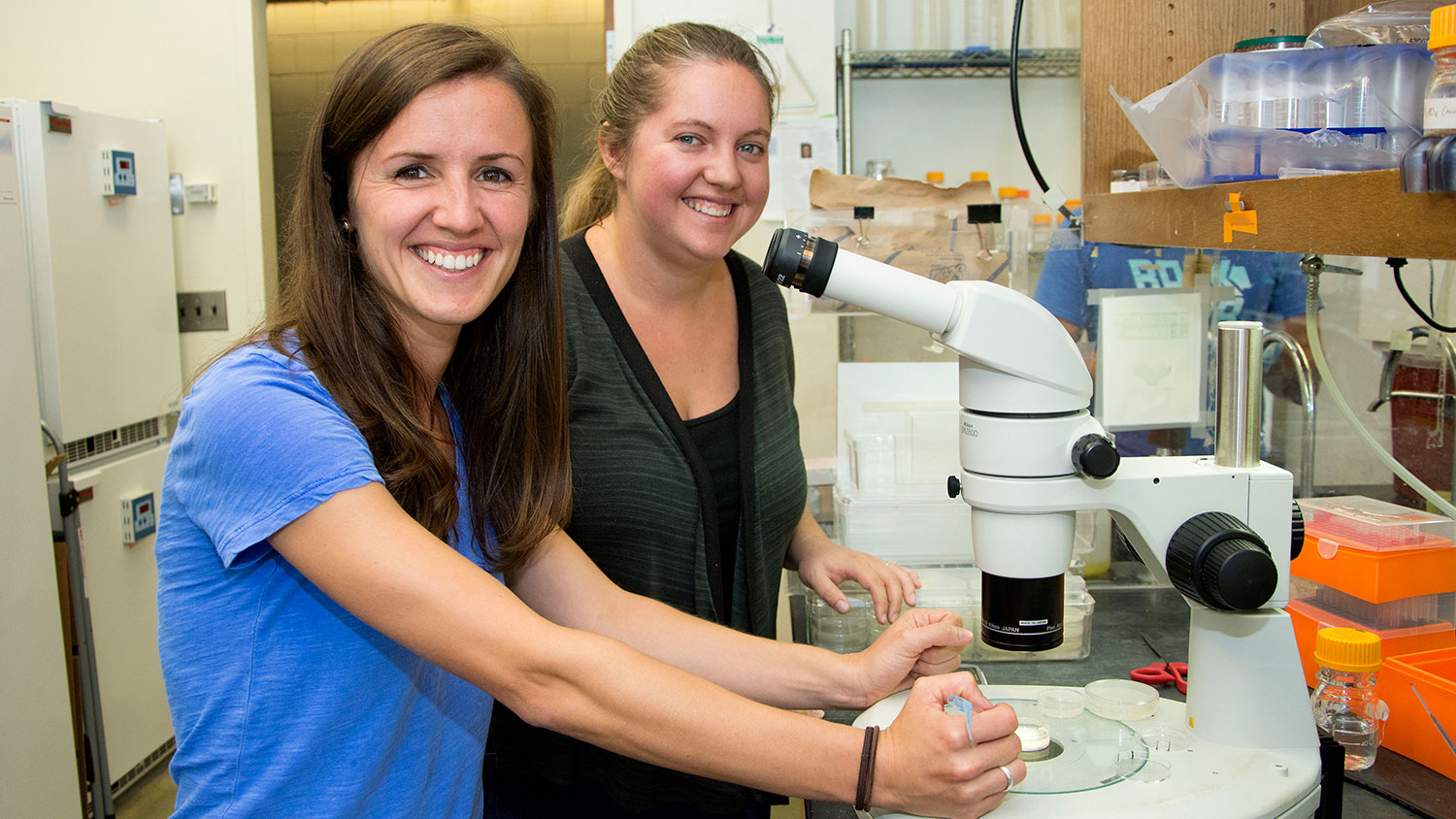
In an all-day class in a research and clinical lab at the center, 14 third-year and four first-year College of Veterinary Medicine students work in pairs not only to learn the proper technique to put a two-pound striped bass under, but also to do exploratory surgery and then suture them up again.
CMAST是该大学的沿海研究实验室,位于卡特雷特社区学院的校园内,是该州,国家和世界各地的许多地点之一,学生们从罗利大学的小学校园学习。
该中心俯瞰着Bogue Sound的河岸,每天与由UNC教堂山,Duke,UNC Wilmington和其他沿海机构经营的类似学术中心合作,并为多个研究领域的NC州学生提供研究和教育机会。
It’s a busy place.
Harms, the director of CMAST’s Marine Health Program since the physical location at the coast opened in 1999, not only oversees the teaching program, but also provides veterinary oversight to the Karen Beasley Sea Turtle Rescue and Rehabilitation Center and several marine mammal and sea turtle stranding networks. And he supports local laboratories, as well as the NC Aquariums.
哈姆斯说:“当我第一次居住在这里时,人们总是问我在海洋实验室要做什么。”““事实是,我们在这里发生的事情要超过我们能跟上的。”
水生,野生动植物和动物医学教授Lewbart于1990年代初首次遇到伤害,并于1998年开始在罗利(Raleigh)与他一起教鱼类外科课程,首先从事宠物鱼类(例如KOI)。多年来,他们在各种物种上进行了腹部手术,CT扫描和活检以及其他程序,从cat鱼到条纹鲈鱼,所有这些都是13亿美元的全球装饰鱼市场的一部分。
“渔业生物学家一直在做这件事,”莱巴特说。“要追踪鱼,您不能在外部放置发射器。鱼不忍受皮肤上的任何东西,因此他们将它们打开,滑入无线电发射器中并能够追踪鱼。”

但是,这种工作从未在教学环境中完成。通常,它是在船的甲板上完成的,几乎是无菌的设置。班级Harms and Lewbart Teach为可能在私人执业中治疗宠物鱼或在展示水族馆中进行水生和海洋哺乳动物护理的学生提供了独特的学习机会,例如Pine Knoll Shores,Fort Fisher或Roanoke Island的水族馆,NC水族馆的三个主要地点。
“When we first started this, many aquariums didn’t have full-time veterinarians,” Lewbart says. “And the ones that did were working on marine mammals, birds and reptiles, not fish. We have seen a big shift in that the last 30 years.
“Most major aquariums now have two veterinarians.”
At the NC Aquariums, the full-time veterinary staff consists of two former CMAST residents, Emily Christiansen and Lori Westmoreland.
Fish Surgery
在四月份的特定日子里,参加本学期的密集课程的18个CVM学生聚集在三层楼高的CMAST大楼的一楼舞台/湿实验室。每对工作对仔细选择了一个条纹鲈鱼,该鲈鱼已由NC State Marine水产养殖研究中心收获和捐赠,在马歇尔伯格(Marshallberg)约25英里外,并发送到了CMAST实验室。
The fish are anesthetized with solution of fish sedative and water in a five-gallon bucket under the guidance of CVM anesthesiologist Julie Balko, then intubated with a plastic tube in the mouth that keeps a flow of water going through the gills of the fish, which are placed on their backs on a plastic box that stabilizes them and drains and recirculates the water throughout the process.

(Harms和Lewbart几年前开发了便携式鱼麻醉装置的基础知识,当时内布拉斯加州的一个动物园要求他们展示自己的技术。这种可移植性最终使他们能够将外科手术从罗利移至海岸。)
学生在低音的下侧进行腹部切口,然后将其覆盖在整形手术窗帘上,以保持皮肤和鳞片湿润。学生在当天晚些时候在楼上的教室中完成外部和内部活检的血液和组织样本。
这些鱼被小心地缝合在一起,就像宠物在类似的探索程序之后可能正在私人练习中,或者在插入发射机以进行跟踪之后可能会出现。在教学期结束时,鱼在麻醉下被安乐死。
A Soft Spot for Fish
对于杰米·斯莱特(Jamie Slater)而言,杰米·斯莱特(Jamie Slater)是UNC威尔明顿(UNC Wilmington)在CVM计划中的第三年,切开鱼并将其缝制回来是一个梦想成真。
Really.
在克利夫兰县长大,当她开始用外来物种填充自己的第一个鱼缸时,她远离沿海水域。当她获得第一个盐水坦克时,她深入了爱好。
Then, as a college student, she had a part-time job in an aquarium store as she pursued an undergraduate degree in biology with a minor in chemistry.
“That’s when I found out that more fish died than were actually being sold,” Slater says. “The hobby made me start thinking about going to vet med school, but I didn’t realize until I got here that I could actually work with fish.
“Now, here I am, and I’m so excited about the fish.”
How excited? She has a channel catfish and a brook trout tattooed down the length of her right arm.
Like all vet med students, Slater has done surgical procedures on other animals.
“I’ve operated on a donkey, a cat, a dog — all of which were castration or spaying,” she says. “I operated on a goat once and did a rumenotomy on a cow.
“不过,我不得不说,鱼是我的最爱。”
That’s exactly what Harms — a native of Iowa and a graduate of Iowa State — wanted to hear when he developed this intensive veterinary class at NC State’s marine lab, which has few peers among vet med colleges across the country.
“I would have killed to have something like this when I was in school,” he says.
-
北卡罗来纳州莫尔黑德市的CMAST设施 -
CVM学生在CMAST的一周班上成对工作。 -
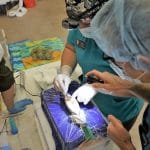
学生在格雷格·勒瓦巴特(Greg Lewbart)教授监督时切开切口。 -
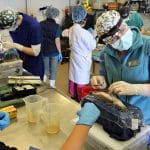
Students use a portable fish anesthesia device developed by professors Craig Harms and Greg Lewbart. -
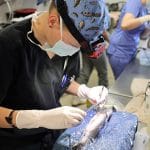
CVM student Jamie Slater says the program is a dream come true. -
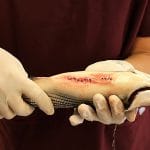
学生展示缝合线工作。


- Categories: